

Last Updated: October 23, 2026
Quick Summary
Choose your cricket bat size by matching your height to a size chart, where the bat should reach roughly to the top of your thigh or just above the hip crease when stood beside your leg. Then confirm the fit with an at-home test: the toe should clear the ground in stance and the bat should feel controllable at half speed.
- Junior bats run size 1 to size 6 for ages 5-12 and heights under 160 cm.
- Senior bats start at harrow, then size 7 short handle, then full size with long handle options.
- In the fit test, the toe should clear the ground by a small gap, not touch it.
- Lighter senior bats of roughly 1.1-1.2 kg suit younger players and quicker hands.
- Size to the child in front of you today rather than buying a bat to grow into.
Table of Contents
- Why the Right Cricket Bat Size Changes Your Game
- Cricket Bat Size Chart by Height
- Cricket Bat Size by Age: Junior and Senior Bat Sizes
- How to Measure Cricket Bat Size: The At-Home Fit Test
- Cricket Bat Weight Guide: Weight, Balance and Pickup
- Sizing by Batting Position, Technique and Reach
- Common Bat Sizing Mistakes to Avoid
- Choosing Your Bat at JR SPORTING GOODS
- Frequently Asked Questions
Why the Right Cricket Bat Size Changes Your Game
A badly sized bat shows within one shot: the player chokes down on the handle or drags the toe through the ground, and both habits wreck timing.
At JR SPORTING GOODS, we fit bats for beginners and league players every week, and the same truth holds: cricket bat size is a starting point for technique, not a footnote on a spec sheet.

Below: the cricket bat size chart by height, junior and senior age bands, a five-minute at-home fit test, plus weight, pickup, and common mistakes.
Cricket Bat Size Chart by Height
Height is the fastest way to narrow the field: a bat should reach roughly to the top of your thigh, or just above the hip crease, when stood beside your leg.
| Player Height | Bat Size | Handle Type | Typical Age Band |
|---|---|---|---|
| Under 122 cm | Size 1 | Short handle | 5-6 years |
| 122-129 cm | Size 2 | Short handle | 6-7 years |
| 130-137 cm | Size 3 | Short handle | 7-9 years |
| 138-144 cm | Size 4 | Short handle | 8-10 years |
| 145-152 cm | Size 5 | Short handle | 9-11 years |
| 153-160 cm | Size 6 | Short handle | 10-12 years |
| 161-168 cm | Harrow | Short handle | 11-13 years |
| 169-175 cm | Size 7 / SH | Short handle | 13+ years |
| 176 cm and above | Full size / LH | Long handle | Adult |
Treat the height range as a filter, not a verdict. Two players at 165 cm can need different bats if one has long arms and the other a short reach, so check the chart, then run the fit test below.
How to Measure a Player's Height at Home
Stand the player against a flat wall, heels together, back straight, head level. Mark the wall at the crown of the head, then measure floor to mark with a tape.
Measure in the evening if you can; players, especially juniors, measure slightly taller in the morning, and that difference can push you to size up a bat they will outgrow in a month.
Cricket Bat Size by Age: Junior and Senior Bat Sizes
Age is a sanity check on the height chart, nothing more. Children of the same age vary wildly in build, so a tall eight-year-old may need a size 4 while a smaller classmate fits a size 2.
Junior bats run size 1 through size 6, built shorter and lighter so young players control the blade through the swing. Senior bats start at harrow, then move through size 7 (short handle) to full size, with long handle options for taller adults.
| Category | Sizes | Best For |
|---|---|---|
| Junior | Size 1 to Size 6 | Ages 5-12, height under 160 cm |
| Transition | Harrow | Ages 11-13, height 161-168 cm |
| Senior | Size 7 SH, Full size, Long handle | Ages 13+, height 169 cm and above |
Growth Planning for Junior Players
Buying a bat for a child is a budget decision as much as a fit decision.
Our guidance for parents: size to the child in front of you today, not the child you expect next spring.
If you want more room, add a slightly lighter bat rather than a longer one. A lighter senior-grade bat in the correct length lets a growing player swing freely while they fill out.
How to Measure Cricket Bat Size: The At-Home Fit Test
The at-home fit test confirms a bat size without a shop visit, checking ground clearance, handle height, and swing freedom in under five minutes.
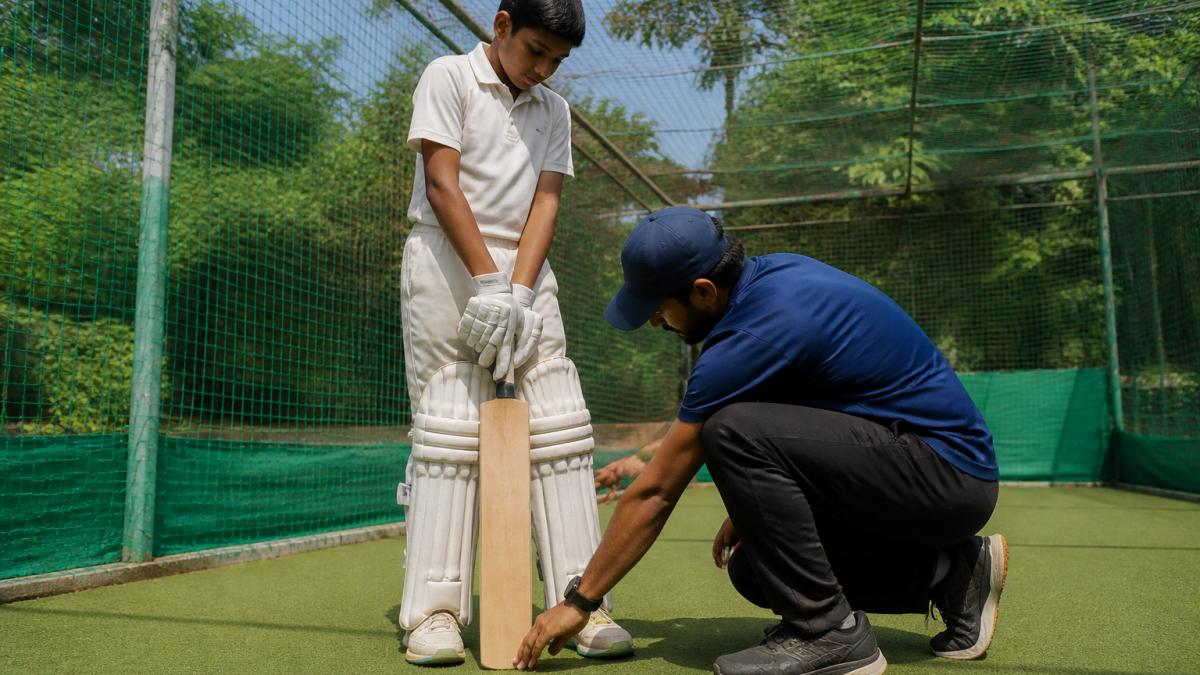
Run these steps with the player in batting shoes on a flat floor:
- Stand the bat upright beside the player's leg, toe on the floor, handle pointing up.
- Check where the top of the handle sits. It should reach roughly to the hip crease, or the top of the thigh.
- Take a batting stance and let the bat hang naturally from the top hand. The toe should clear the ground by a small gap, not touch it.
- Shadow a front-foot drive. If the toe digs into the floor, the bat is too long.
- Shadow a back-foot punch. If the bat feels unwieldy or the top hand cannot control it, the bat is too heavy or too long.
- Grip the handle and check that the top hand wraps comfortably, with the V between thumb and forefinger pointing down the blade.
If the bat passes all six checks, it is the right length for that player. If it fails step 3 or 4, drop one size. If it fails step 5, keep the length and move to a lighter model.
Cricket Bat Weight Guide: Weight, Balance and Pickup
Weight and pickup are not the same thing, and confusing them is where most buyers go wrong. Weight is the number on the sticker; pickup is how heavy the bat feels when you swing it.
A 1.2 kg bat can feel light if the weight sits low in the blade with a thin handle, or feel like a log if the weight sits high or the handle is thick.
How to Assess Pickup and Swing Control
You do not need a lab to judge pickup. Run this three-part check:
- The one-hand hold. Grip the bat with your top hand only, arm extended, and hold it steady for five seconds. If the tip dips or your wrist tires quickly, the bat is too heavy for that player's strength.
- The figure-eight swing. Swing the bat in a slow figure-eight for ten repetitions. A well-balanced bat tracks smoothly; a poorly balanced one pulls your hand off the path or feels like it is dragging.
- The shadow drive. Shadow a front-foot drive and a back-foot punch at half speed. You should feel the bat head arrive without muscling it. If you have to squeeze hard to control the blade, the pickup is too heavy regardless of the sticker weight.
A player who cannot control a bat at half speed will not control it at match speed. Pickup, not sticker weight, predicts timing.
Matching Weight to the Player
Use this framework to match weight to the player rather than to a number:
JR Plastic Cricket Bat – Lightweight Durable Cricket Bat for Kids & Beginners →
- Lighter bats (roughly 1.1-1.2 kg for seniors): quicker hands, better for younger players, T20-style hitting, and anyone recovering from injury or building confidence.
- Mid-weight bats (roughly 1.2-1.3 kg): the safe default for club and league players who want a balance of control and power.
- Heavier bats (roughly 1.3 kg and above): more momentum through the ball, best for strong adult players with a settled technique. Heavier bats punish late hands and are rarely the right first bat.
These ranges are guides, not rules: a strong 15-year-old may handle a mid-weight senior bat, while a small adult may be better served by a lighter senior model. Let the pickup test override the sticker.
Balance Point and Sweet Spot
Balance point is where the bat balances on a finger under the blade. Closer to the handle feels lighter to swing; toward the toe feels heavier and delivers more momentum.
Sweet spot height matters too: a higher spine raises it, suiting back-foot players who hit through the line; a lower sweet spot suits front-foot players who drive on the up.
Bat Dimensions Beyond Overall Length
Length is only one measurement; blade width, edge thickness, spine height, and handle length all affect how a bat plays.
Standard blade width is around 10.8 cm, the maximum allowed under the Laws of Cricket, and most senior bats sit close to that.
Handle length matters too: a short handle suits most players, while a long handle gives taller batters a more upright stance and helps reach at the crease.
Sizing by Batting Position, Technique and Reach
Two players of the same height can need different bats because of how they bat. Position and technique change the ideal size and weight more than most buyers expect; the height chart gets you into the right band, this section helps you choose within it.
How Stance and Grip Affect Bat Length
A player's natural stance changes how much bat length they can use. A tall, upright player with a high backlift needs a bat reaching the hip crease without forcing a crouch, while a player who crouches low can often use a slightly longer bat because the toe has more room to clear the ground.
Grip style matters too: gripping at the very top of the handle effectively adds length, choking down shortens it. A player who naturally grips low may suit a shorter bat or a long handle better than the chart suggests.
Reach and Handle Length
Reach is the distance from the shoulder to the bottom hand in stance. Players with long arms and a tall frame often feel cramped by a short handle, which forces them to bend at the crease; a long handle model keeps the stance taller and the swing path cleaner.
Conversely, a player with a short reach may prefer a shorter handle to keep the hands close to the body and the bat under control.
Sizing by Batting Position
- Openers: spend long periods at the crease and value control over power. A mid-weight, balanced blade with a mid sweet spot lets them bat for hours without tiring.
- Middle-order hitters: attack from ball one and can carry a heavier bat with a lower sweet spot to generate power through the line.
- Wicketkeeper-batters and finishers: often prefer a lighter pickup for quick hands and late adjustments.
Technique: Front-Foot vs Back-Foot Players
A front-foot player who drives on the up benefits from a lower sweet spot and a bat that feels balanced through the swing. A back-foot player who cuts and pulls benefits from a higher sweet spot and a bat that carries momentum through the ball. Neither profile is 'correct', match the bat to the player's dominant scoring areas.
Common Bat Sizing Mistakes to Avoid
Six mistakes account for most bad bat purchases we see. Each one is fixable before you spend money.
- Sizing up for growth. A bat that is too long teaches bad habits. Size to today.
- Ignoring pickup. Weight on the sticker tells you little. Swing the bat before you buy.
- Choosing by age alone. Height and build matter more than the number of birthdays.
Choosing Your Bat at JR SPORTING GOODS
The right bat comes down to three checks: height against the size chart, ground clearance in stance, and pickup in the swing. Get those right and the rest is preference.
At JR SPORTING GOODS, we stock bats across the full junior and senior range, from the lightweight JR Plastic Cricket Bat for beginners and backyard practice to English willow models for league players.

Ready to find your fit? Browse our cricket bats, check the size chart against your height, and add the bat that matches your game to your cart.
Frequently Asked Questions
Is a size 28 bat too big for a 7-year-old?
For most 7-year-olds, a size 28 bat is too big. Size 28 usually suits players around 137-145 cm tall, which is closer to ages 9-11. A typical 7-year-old fits a size 3 to size 5 bat, roughly 76-84 cm. The practical test: have the child stand in their stance and hold the bat down beside their front leg. The toe should sit just above the ground. If the toe drags or the bat pulls their hands down, it's too long. A bat that's too big slows the swing and encourages bad habits early.
Should I use a 33-inch or 34-inch cricket bat?
Most adult players fit a 33-inch short handle bat (SH), which suits heights from about 170 cm upward. A 34-inch long handle or long blade bat is for taller players, generally above 183 cm, or for players who want extra reach at the crease. Don't pick a 34-inch bat purely for reach. The longer the bat, the heavier it tends to feel and the harder it is to control. Use the cricket bat size chart by height as your starting point, then check the pickup before committing.
How do I measure myself for a cricket bat?
Stand barefoot against a wall and measure your height in centimetres with a tape measure. Match that number to a height-based size chart. Then do the ground clearance test: stand in your batting stance, hold the bat down beside your front leg, and check that the toe sits just above the ground. Finally, lift the bat into a few practice swings. If you can't control it with one hand at the top of the handle, it's too heavy for your current strength.
How should a cricket bat feel when I pick it up?
A well-sized bat should feel light enough to swing freely and move through the line of the ball without strain. Pick it up with one hand near the top of the handle and swing it gently. You should feel the weight balanced, not dragging toward the toe. The handle should sit comfortably in your grip without your fingers stretching. If your wrists ache after a few swings or the bat feels like it's pulling you forward, try a lighter or shorter option.
Can using a cricket bat that is too big affect my batting?
Yes, significantly. An oversized bat slows down your swing, which costs you reaction time against faster bowling. It also changes your stance and grip as you compensate for the extra length and weight, which can lock in poor technique. For juniors, a bat that's too big is one of the most common reasons young players struggle to time the ball. Getting the cricket bat size right early makes it easier to build a repeatable, confident swing.
What is the difference between junior and adult cricket bat sizes?
Junior bats run from size 0 up to size 6 and cover heights roughly from 120 cm to 163 cm. Harrow bats bridge the gap for players around 165-170 cm. Adult bats start at short handle (SH), usually 33 inches, for players around 170 cm and above, with long handle and long blade options for taller players. The main differences are overall length, blade width and weight. A junior bat is shorter and lighter so younger players can control it through the swing.
Finding the right bat size should not feel like guesswork. JR SPORTING GOODS stocks junior and senior bats across every size band, with English willow models for players who want power and balance, and a team that helps you match length, weight, and handle to your game. Add the bat that fits you today to your cart and step to the crease with equipment built for your swing.
