

Last Updated: October 26, 2026
Quick Summary
No published dataset compares cricket bats and football jerseys like for like, so the honest answer is that they are not competing products. Cricket bats are playing equipment sold to active players, while football jerseys are fan apparel sold to anyone who supports a team, which explains most of the volume gap.
- The cricket bat segment accounted for 39.18% of the cricket apparel and equipment market in 2025.
- The bat market is forecast at $229.1 million in 2025, reaching $373.2 million by 2035.
- Football shirts are projected at $7.21 billion in 2026, a separate category with different methodology.
- A batsman typically buys one bat every few seasons, while a supporter can buy several shirts a year.
- Cricket bat demand is deep in fewer countries; football shirt demand is broad across many countries.
Table of Contents
- Why Cricket Bats and Football Jerseys Are Not a Fair Fight
- Cricket Equipment Market Demand in Numbers
- Football Jersey Sales and the Shirt Market
- Cricket Bats vs Football Jerseys: A Side-by-Side Comparison
- Regional Popularity: Where Each Product Sells
- Seasonal Demand for Sports Equipment and Match-Day Apparel
- How Fan Loyalty and Licensed Merchandise Shape Buying
- Choosing the Right Cricket Gear or Jersey for Your Game
- Frequently Asked Questions
Why Cricket Bats and Football Jerseys Are Not a Fair Fight
Search "cricket bats vs football jerseys demand" and you will find plenty of confident answers built on nothing. The honest position, and the one we take at JR SPORTING GOODS, is that no published dataset compares the two products like for like.
Here is the first thing to understand: cricket bats and football jerseys are not competing products. One is a piece of playing equipment sold to people who actually bat. The other is fan apparel sold to anyone who supports a team.
What the Numbers Actually Measure
Market demand is the total volume of a product bought in a defined period, measured in units or revenue. Most "vs" comparisons fail because they mix categories, currencies and years.
The Grand View Research cricket apparel and equipment analysis values the global cricket apparel and equipment market at $2.0 billion in 2025, rising to a projected $2.7 billion by 2033 at a 3.7% CAGR. That figure bundles bats, pads, helmets and shirts into one number.
A separate Business Research Insights football shirts market report puts football shirts at a projected $7.21 billion in 2026. Different category, different methodology, different buyer. Set them side by side and you learn almost nothing.
Cricket Equipment Market Demand in Numbers
Cricket's equipment market is smaller than football's apparel market but growing steadily. Mordor Intelligence estimates the cricket apparel and equipment market at $0.95 billion in 2026, reaching $1.31 billion by 2031 at a 6.81% CAGR. Fortune Business Insights projects cricket equipment alone growing from $871.34 million in 2026 to $1,267.04 million by 2034.
Those are forecasts, not sales receipts. Treat them as direction, not gospel.
Bats Hold the Largest Share of Cricket Spending
Bats are the single biggest product segment in cricket. According to Mordor Intelligence's cricket market research, the cricket bat segment accounted for 39.18% of the cricket apparel and equipment market in 2025.
The bat market itself is forecast at $229.1 million in 2025, reaching $373.2 million by 2035 at a 5.0% CAGR, per Market.us cricket bat market data. That is a specialist purchase: a player buys one bat and keeps it for seasons.
Football Jersey Sales and the Shirt Market
Football jerseys behave like fashion and fandom, not equipment. A supporter can own five shirts in a season and still never kick a ball. That repeat-purchase pattern is why the shirt category scales so much larger on paper.
The gap in stated market value is real but misleading. A $7.21 billion shirt projection against a $229.1 million bat projection reflects two different things being counted, not one product outselling another tenfold in units.
Cricket Bats vs Football Jerseys: A Side-by-Side Comparison
Most "vs" articles put a bat and a shirt in the same table and call it a comparison. That table is usually misleading, because the two products are not measured the same way.
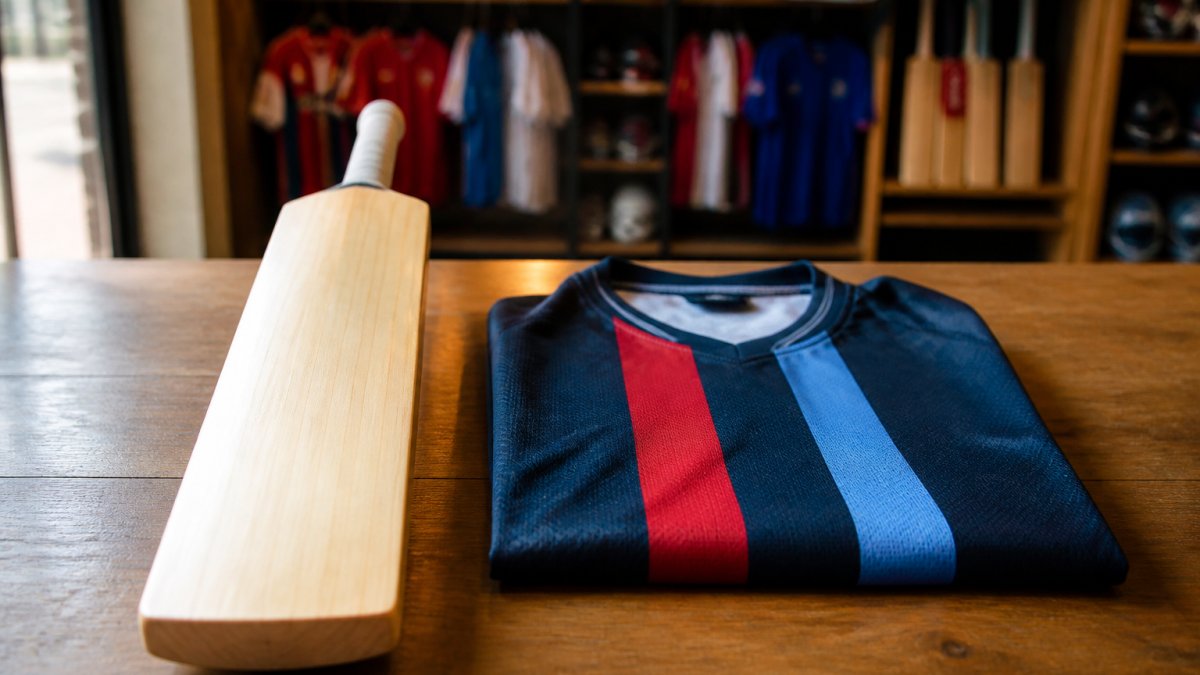
The Methodology Gap Nobody Publishes
No public dataset tracks cricket bats and football jerseys in the same units. Market reports value cricket equipment as a bundle (bats, pads, helmets, shirts) and football shirts as a separate apparel category, often in different currencies and different base years. That is why a $7.21 billion shirt projection can sit next to a $229.1 million bat projection without either figure being wrong.
A defensible comparison therefore uses three rules:
- Same unit. Compare units sold, not stated market value, wherever a unit estimate exists.
- Same buyer. Separate match-play buyers from fan-apparel buyers before comparing.
- Same period. Use the same calendar year and note whether the figure is actual, estimated, or forecast.
Where a rule cannot be met, the comparison should say so rather than force a number.
Buyer Type Is the Real Dividing Line
| Dimension | Cricket Bats | Football Jerseys |
|---|---|---|
| Primary buyer | Active player who bats | Supporter, plus casual players |
| Purchase occasion | New season, replacement, size change | New kit launch, tournament, gift |
| Typical ownership | One bat at a time, kept for seasons | Multiple shirts per season |
| Decision driver | Weight, pickup, willow grade, profile | Team identity, fit, sponsor design |
| Replacement trigger | Crack, handle failure, weight preference | Design change, size, fashion |
| Licensing exposure | Low | High |
| Counterfeit risk | Moderate (branded bats) | High (replica shirts) |
A batsman buys a bat to perform. A supporter buys a shirt to belong. That single difference explains most of the volume gap between the two categories, and it is the point most comparisons skip.
What a Like-for-Like Comparison Can Actually Say
Using consistent measures, three claims survive scrutiny:
- Unit volume favors jerseys. A supporter can buy several shirts a year; a batsman typically buys one bat every few seasons. Even without a published unit count, the repeat-purchase pattern points one way.
- Revenue per buyer favors bats. A match-grade English willow bat costs more than a replica shirt, so fewer buyers can still produce meaningful category value.
- Search interest is seasonal and event-led for both. Bat searches cluster around the start of a season; shirt searches cluster around kit launches and tournaments. Neither is a steady year-round curve.
Where the Comparison Breaks Down
The comparison fails when a market report bundles bats with pads and helmets, or when a shirt figure includes training wear and fashion replicas. It also fails when a forecast is treated as a sales receipt. Most practitioners find that the cleanest comparison is buyer-level: how often each product is bought, by whom, and why. That framing is more useful to a retailer than any single headline market value.
Regional Popularity: Where Each Product Sells
Geography is the single biggest reason the two categories look so different on paper. Cricket demand concentrates in a small number of deep markets. Football demand spreads across many shallower ones. That difference in reach, not product quality, drives most of the volume gap.
India T20 World Cup Shirt 2026 →
A Country-by-Country View
The table below compares the two products by market type rather than by a single global figure, because a global figure hides the concentration that matters to a retailer.
| Market type | Cricket bats | Football jerseys |
|---|---|---|
| South Asia (India, Pakistan, Bangladesh, Sri Lanka) | Very high participation; bats are a core purchase | High and growing; club and national shirt demand strong |
| Australia and New Zealand | Strong summer-season bat demand | Moderate; A-League and national team shirts |
| United Kingdom | Season-led bat demand; strong club cricket base | Very high; Premier League shirt demand dominates |
| Caribbean | High per-capita cricket interest; franchise leagues growing | Moderate; national team and club shirts |
| Europe (excluding UK) | Niche; growing via expat and club cricket | Very high; top-five league shirts drive volume |
| South America | Niche | Very high; club loyalty is a primary purchase driver |
| Africa | Strong in South Africa and Zimbabwe; growing elsewhere | High and growing across multiple markets |
| North America | Niche but rising, especially among South Asian diaspora | High; MLS and European club shirts |
Two patterns stand out. First, cricket bat demand is deep in fewer countries. Second, football shirt demand is broad across many countries, and it does not depend on the buyer ever playing the sport.
Why Reach Beats Depth on Volume
A cricket bat buyer is almost always a player. That limits the buyer pool to people who actually bat, which is a large but bounded group concentrated in cricket-playing nations.
That is the mechanism behind the volume gap. It is not that football is more popular everywhere; it is that football fandom converts to apparel purchases in more places and among more non-players.
What This Means for a US-Based Buyer
In the United States, cricket is a growing niche rather than a mass market, and demand is strongest among diaspora communities and club players. Football shirt demand is mainstream.
You can see team-specific demand play out in practice by browsing a USA T20 World Cup cricket jersey or a Pakistan T20 World Cup shirt. The pattern is the same in both: demand spikes around a tournament and then settles back to a committed base.


The Limit of Regional Claims
Regional comparisons are useful but easy to overstate. A country with a large population does not automatically produce large bat sales, and a country with a strong league does not automatically produce large shirt sales outside its own borders. The reliable signal is participation plus team loyalty, measured separately, not a single "popularity" ranking.
Seasonal Demand for Sports Equipment and Match-Day Apparel
Seasonal demand for sports equipment peaks around the start of a playing season and major tournaments. Bats move in the weeks before league cricket begins. Jerseys spike during World Cups, continental championships and club trophy runs.
The two cycles rarely overlap neatly. A retailer stocking both carries risk in different months, which is why planning inventory around tournament calendars matters more than chasing a single "peak season".
How Fan Loyalty and Licensed Merchandise Shape Buying
Licensed merchandise turns loyalty into revenue. Football clubs and national teams license heavily, and replica shirts carry sponsor logos, home and away kit variants, and yearly design changes that push repeat purchases.
Cricket's licensed market is smaller but growing, particularly in franchise leagues. A Trinbago Knight Riders replica jersey shows the model working: team branding, sponsor detail and a design fans want to wear beyond match day.
Watch out: counterfeit merchandise undercuts licensed sales in both sports, and buyers who chase the cheapest shirt often end up with stitching that fails after one wash. Licensing exists partly to protect buyers from that.
Choosing the Right Cricket Gear or Jersey for Your Game
The right purchase depends on whether you are buying equipment or apparel. If you play, buy the bat first and buy it properly.
For players, an English willow bat with a full profile and thick edges suits club and league cricket. Our SS Tiger English Willow cricket bat is built for adult and senior players who want power hitting and a balanced pickup, and it ships with a cover.
For fans, replica shirts range from budget to premium. An India T20 World Cup shirt sits at the top end of what most supporters spend, while entry-level options cover casual buyers.

Best for: players who need match-grade equipment and fans who want team apparel from one place. Skip if: you only need a single novelty item and are not fussed about material or fit.
Frequently Asked Questions
Do fans buy more cricket equipment or football jerseys?
The two categories are measured differently. Football shirts were projected at USD 7.21 billion in 2026, while the global cricket bat market was forecast at around USD 230 million for the same year. That gap partly reflects what each product is: a jersey is cheap fan apparel bought by millions, while cricket bats are durable equipment bought by players. A football fan may own several shirts; a cricketer usually owns one or two bats. Comparing the two requires matching the categories first.
What factors affect demand for cricket bats?
Bat demand follows player numbers, league participation, and replacement cycles rather than casual fan spending. Bats held 39.18% of the cricket apparel and equipment market in 2025, according to Mordor Intelligence, which makes them the single largest product segment. Price matters too: an English willow bat like the SS Tiger 2026 at $179.00 is a considered purchase, so buyers research grain, weight, and handle shape before committing. Proper knocking-in and care also extend a bat's life, which slows repeat buying.
When do football jerseys sell best?
Jersey sales peak around major tournaments and the start of domestic seasons, when new kits launch and fans want the current design. This is the seasonal demand for sports equipment pattern in action: apparel spikes with events, then settles. Cricket follows a similar rhythm around T20 World Cups and league seasons, which is why replica shirts like the Trinbago Knight Riders jersey at $34.99 tend to move fastest during competition windows rather than mid-season.
How do cricket and football merchandise buyers differ?
Football buyers are mostly supporters buying to show allegiance, so they respond to team branding, sponsor logos, and kit design. Cricket buyers split into two groups: fans who want jerseys, and players who need protective equipment, gloves, helmets, and bats that perform. That second group cares about specifications, not just looks. A cricket player shopping for a bat will check the playing area and edge profile; a football fan buying a shirt checks the fit and the badge.
Demand data will never settle the cricket-versus-football argument, because the two products serve different buyers. What it can do is help you buy well. At JR SPORTING GOODS, we stock cricket bats, protective gear and replica jerseys with a customer-first approach built on listening to what players and fans actually ask for. Get started with JR SPORTING GOODS and equip yourself with gear that matches how you play and who you support.
